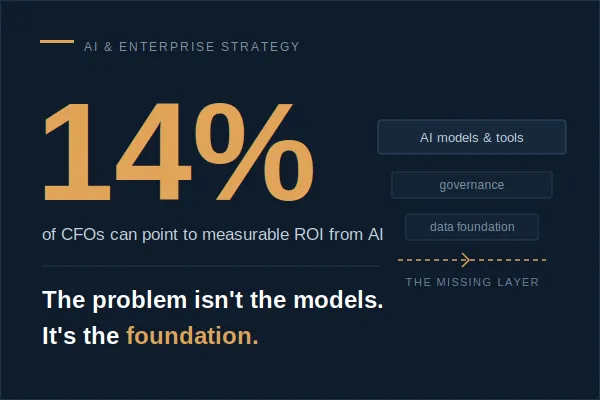
Only 14% of CFOs Can Point to Measurable ROI from AI. The Problem Isn't the Models. It's the Foundation.
Artificial intelligence has quickly become one of the largest strategic investments organizations are making today. Executive teams are evaluating copilots, AI agents, predictive analytics, and generative AI platforms with the expectation that these technologies will improve productivity, accelerate decision-making, and create measurable business value. Yet despite the enthusiasm, one statistic continues to stand out: only a small percentage of CFOs report being able to measure meaningful return on their AI investments.
That number doesn't surprise me.
Not because AI lacks potential, but because I believe most organizations are trying to solve the wrong problem. The discussion often begins with selecting models, evaluating vendors, or comparing capabilities. Those are important decisions, but they're rarely the decisions that determine long-term success. In my experience, organizations don't struggle because they chose the wrong AI platform. They struggle because their data foundation was never prepared to support enterprise AI in the first place.
One of the characteristics that makes artificial intelligence so powerful is also what makes it unforgiving. AI doesn't improve the quality of your data. It scales whatever already exists. If business definitions are inconsistent, AI will produce inconsistent answers more efficiently. If critical information is fragmented across multiple systems, AI simply becomes faster at navigating fragmented information. If governance is weak, AI accelerates governance problems rather than solving them. The technology is doing exactly what it was designed to do. The challenge is that it reflects the maturity of the environment surrounding it.
Throughout my career, I've spent far more time helping organizations build enterprise data capabilities than evaluating AI models. That's because successful AI initiatives almost always begin long before anyone deploys a large language model. They begin by establishing trusted data, consistent governance, clear ownership, and well-defined business terminology. Those investments rarely generate headlines, but they determine whether AI becomes a reliable business capability or another isolated proof of concept.
One of the misconceptions surrounding enterprise AI is that implementation is primarily a technology project. In reality, it's an architectural project. Every organization already has an existing ecosystem of operational systems, data warehouses, integrations, reporting platforms, security controls, and governance processes. AI doesn't replace that architecture. It becomes another layer within it. If the underlying architecture is healthy, AI can create extraordinary value. If it isn't, AI simply exposes weaknesses that have existed for years but were easier to ignore.
I've seen organizations successfully demonstrate impressive AI capabilities in controlled environments, only to struggle when they attempted to scale those same capabilities across the enterprise. The models performed exactly as expected. The architecture didn't. Data quality varied by department. Business rules differed across applications. Metadata was incomplete. Ownership became unclear. Security teams needed greater visibility into how information was being accessed and used. None of those challenges were caused by artificial intelligence. They were architectural realities that became impossible to overlook once AI began depending on them.
This is one of the reasons I encourage executive teams to change the questions they're asking. Rather than beginning with, "Which AI platform should we invest in?" I prefer to start with, "Is our enterprise prepared to support AI at scale?" That single shift changes the entire conversation. It moves leadership away from comparing products and toward evaluating organizational readiness. It reframes AI as a business capability instead of a software purchase.
Artificial intelligence will continue evolving. Models will become more capable, costs will change, and entirely new approaches will emerge over the next several years. Organizations that continuously chase the newest technology may experience periodic success, but the companies that consistently create value will be the ones that invested in something much more durable: an enterprise data foundation that supports every generation of AI that follows.
Technology changes quickly.
Architecture changes much more slowly.
That's precisely why it's worth investing in.


